Congress moves to restrict license plate cameras
Nine pending bills seek federal rules for automated surveillance systems after bipartisan complaints over privacy and oversight.
By Ricardo Alvarez ·
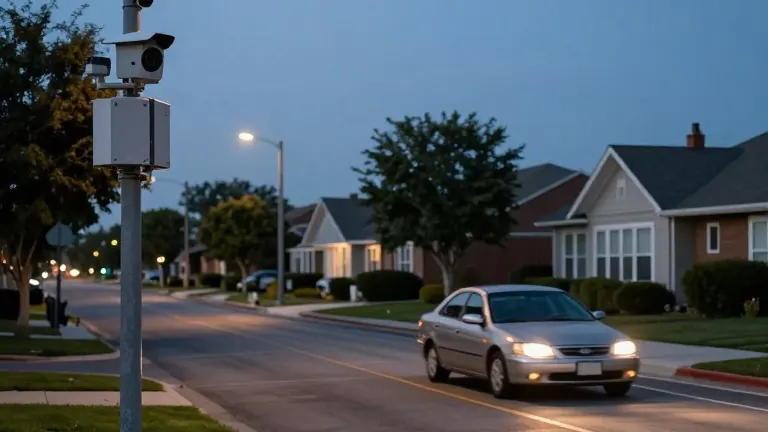
For drivers in Suffolk County and across the nation, the debate over automated license plate readers has moved from local town halls to the floors of Congress. Lawmakers from both parties are now pushing for federal legislation to standardize how these cameras are used, ending a patchwork of local rules that currently govern the technology.
The push follows a year-long investigation into Flock Safety, the largest provider of the technology. The company states it operates more than 120,000 cameras in 49 states, connecting over 6,000 law enforcement agencies to a national data-sharing network. This connectivity allows a small local department to search data captured by devices thousands of miles away, a scope that critics argue lacks sufficient oversight.
Rep. Greg Steube, a Florida Republican who sits on the House Permanent Select Committee on Intelligence, filed his own bill in the days before this report. He cited the technology as a rare area of agreement between the political extremes. "It’s probably one of the very few things that Bernie Sanders and I agree upon," Steube said. He argued that without a nationwide regulatory framework, every agency operates under different policies, creating inconsistency in how citizens' data is handled.
Nine legislative efforts are currently pending or expected. These proposals vary widely in their approach. H.R. 9800, introduced by Rep. Tim Burchett, R-Tennessee, would bar federal agencies from buying or operating automated surveillance systems. H.R. 10221, the Flock-Off Act, introduced by Rep. Thomas Massie, R-Kentucky, would cut federal funds for these systems. H.R. 10606, introduced by Steube, would generally bar federal access unless a warrant is obtained. H.R. 10691, introduced by Rep. Alexandria Ocasio-Cortez, D-New York, would prohibit federal use unless Congress passes a specific authorization law limiting data retention to 48 hours. H.R. 10822, introduced by Rep. Pat Harrigan, R-North Carolina, includes a warrant requirement and a ban on indexing expressive attributes like bumper stickers.
Sen. Ron Wyden, D-Oregon, took a different tactical approach, urging communities to take local control. He said, "I’m recommending that people close up those cameras. Make it a local choice." Wyden noted that residents in his district are tired of having their privacy rights compromised and want to decide for themselves whether to accept the technology.
Flock Safety responded to the legislative activity through a spokesperson. The company described its technology as an important public safety tool that helps officers solve serious crimes and find missing people. It stated that it supports thoughtful, bipartisan legislation that puts strong privacy and accountability guardrails in place while preserving law enforcement’s ability to use technology responsibly.
The legal stakes have risen following a ruling by a federal judge in October. The judge called the technology a large-scale, dragnet-type surveillance system. The ruling found that an Oklahoma officer’s warrantless search of the database violated the Fourth Amendment because it lacked probable cause. The judge wrote that it becomes constitutionally problematic when law enforcement can indiscriminately catalog a person's whereabouts over an extended period.