Netanyahu and Eisenkot tied as Israel seeks path past 61-seat threshold
Exit polls scheduled for Tuesday night will reveal if either bloc can secure the majority needed to avoid another cycle of deadlock.
By Harvey Wilson ·
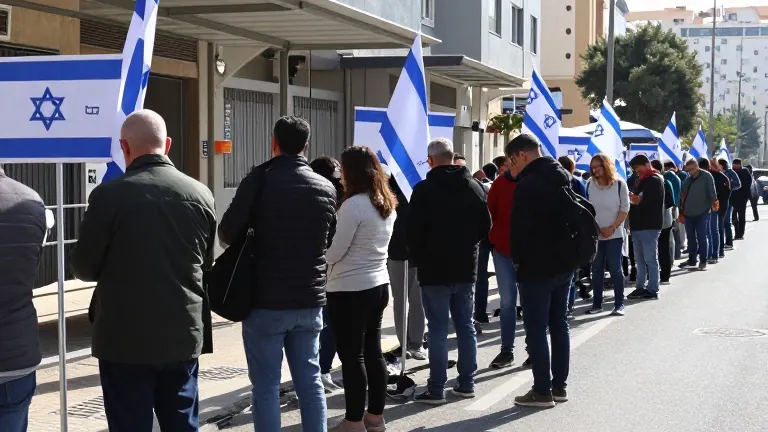
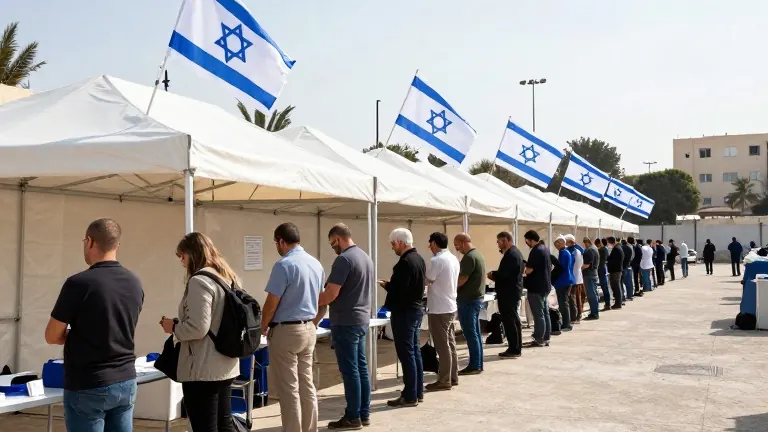
Isaac Levi, a 24-year-old reservist stationed near the Gaza border, has not slept in four days. He is one of hundreds of thousands of Israeli soldiers who will cast their ballots before returning to their posts, knowing that many of their votes will not be tallied until Wednesday. For ordinary Israelis, the coming weeks hinge on whether their vote lands in the camp of Prime Minister Benjamin Netanyahu or former military chief Gadi Eisenkot, a choice that determines whether the country continues its current trajectory or pivots toward a new alliance.
Polling released on Friday places the two men in a near tie. Neither their political blocs are projected to command the 61 seats required to form a majority government in the Knesset. This mathematical reality sets the stage for weeks of intense negotiation. The opposition has spent the campaign attacking Netanyahu over the security failures that preceded the October 7, 2023, Hamas attacks, in which nearly 1,200 people were killed and 251 were taken hostage. Netanyahu, who has resisted calls for an independent commission of inquiry, has instead emphasized his record as a security leader and his close relationship with US President Donald Trump.
The contest is defined by complex alliances rather than a simple duet. Eisenkot leads the Yashar Party, the anchor of a diverse change bloc that includes right-wingers Naftali Bennett and Avigdor Lieberman, as well as left-leaning general Yair Golan. Netanyahu relies on his existing coalition with far-right and ultra-Orthodox parties, a grouping described as the most right-wing in Israeli history. The inclusion of two Arab party blocs adds another variable. While roughly one-fifth of the population identifies as Arab, nearly all leading Jewish parties have ruled out formal cooperation with them, leaving them as potential informal kingmakers if they can negotiate support.
Tensions escalated in the final days of the campaign. Channel 12 reported that Netanyahu pushed for a military confrontation with Iran before the vote, a move opposed by military chief Eyal Zamir. CNN later reported that Netanyahu sought US approval for strikes on Iran, which Trump reportedly refused. Netanyahu denied both accounts. He also drew attention by posting an AI-generated image of a nuclear bomb striking Tel Aviv, a move Eisenkot labeled hysterical. The issue of conscription remains a flashpoint, with the government failing to enforce a Supreme Court ruling requiring ultra-Orthodox men in full-time religious study to serve in the military.
The stakes extend to the status of the occupied territories. Eisenkot supports Israeli settlements in the West Bank, which are illegal under international law, but has pledged to crack down on extremist settler violence. He has floated the idea of granting Palestinians autonomy or a state-minus arrangement under Israeli security control, a stance that departs from the two-state solution that has largely vanished from mainstream politics. The war in Gaza continues, with the Israeli military reporting more than 74,000 deaths in the territory since the conflict began, according to figures from the Hamas-run health ministry.
As polls close at 22:00 local time, exit surveys will offer the first indication of the outcome. The Likud party is gathering in Jerusalem, while the newly formed Yashar party is assembling in Tel Aviv. The delay in counting military ballots could shift the final tally in favor of right-wing parties that hold strong support among that demographic. If no bloc reaches the majority threshold, Israel faces the prospect of deadlock, a scenario that led to five elections between 2019 and 2022. In that event, Netanyahu would remain in power as interim prime minister while a new campaign begins.
An estimated 70,000 Israelis have flown home from abroad to participate in the vote. Hundreds of thousands of first-time voters are also at the polls. The complexity of the electoral arithmetic means that the final government may be determined less by the initial vote count and more by the concessions, deals, and strategic calculations made in the days following Tuesday night.
Source: BBC News